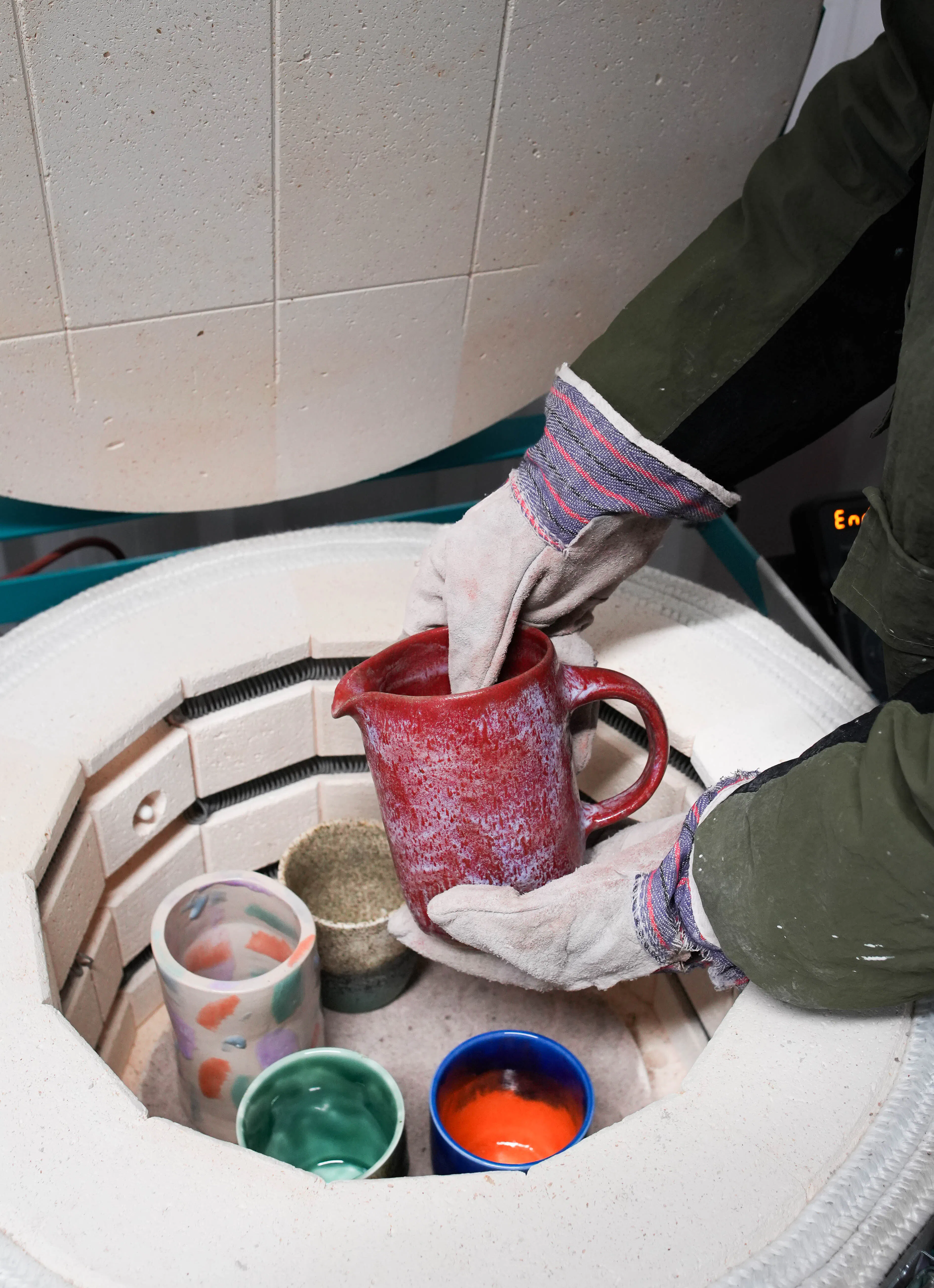
A guide to kiln firing services in London.
A guide to kiln firing services, what they cost, and why they are harder to run than they look.
If you make pottery without a kiln, at some point you hit the same wall.
The work is made, it has dried, and there is nowhere to fire it. A domestic oven will not do it. Clay needs to reach temperatures a kitchen cannot approach, often above 1200°C, before the body matures and a glaze melts into glass. Until then a pot is just shaped, dusty earth. This is the quiet problem behind a lot of home ceramics, and it is why kiln firing services exist.
This is a guide to firing your work in London: what a firing service actually does, what to expect it to cost, what to check before you hand your pots over, and where to go. We run one ourselves, in Peckham, so we will be honest about that at the end rather than pretending otherwise.
What a firing service does
Most work goes through the kiln twice.
The first firing is the bisque usually around 1000°C. It drives out the last water and burns off organic matter, turning fragile bone-dry clay into something porous and strong enough to handle and glaze. The second is the glaze firing, taken higher, to the temperature your glaze and clay body are designed for. Mid-fire stoneware commonly lands at cone 6, roughly 1220 to 1240°C, where the glaze melts and the clay vitrifies.
Cones are the giveaway that a studio knows what it is doing. A pyrometric cone bends at a set combination of heat and time, so a witness cone placed in the load is physical proof the kiln reached maturity, not just a number a controller claimed. If you care about your results, it is worth asking whether a service witnesses its firings.
A firing service takes care of the loading, the programming, the electricity and the cooling, and hands your work back fired. What it does not usually do is glaze for you. Almost every service in London fires only work you have glazed yourself, with materials you can name, because an unknown glaze is a risk to the kiln and to everyone else's pots in the load.
Why firing services are hard to run
It is worth understanding the economics, because it explains the rules and the prices you will meet.
Electricity is the obvious cost, and it has moved.
A single stoneware firing draws a serious amount of power, and energy prices across the sector have climbed steeply. Some London studios have raised their firing prices specifically because their supplier costs rose, in at least one case doubling. When you see a firing quoted higher than you expected, this is usually why.
Kilns wear out in a way you pay for slowly.
Elements have a finite number of firings in them before they need replacing, and a set is not cheap. Shelves and posts chip, warp and get glaze-scarred. Every firing spends a little of that hardware, and a good service has to price that wear in even though it never appears on a single invoice.
The real danger is other people's materials.
A glaze that runs, or a clay body fired past its range, does not just ruin one pot. It can weld work to a shelf, damage the shelf, or splash a neighbour's piece in a shared load. This is why services ask you to declare your clay and glaze, refuse anything undocumented, and insist bases are wiped clean. It is not bureaucracy. It is the difference between a service that survives and one that cooks its own kiln.
Time is the constraint nobody sees.
A firing is not an afternoon. Load, fire, then wait for a slow, controlled cool, often a full day or more, before the kiln can be opened without thermal-shocking the work. That cadence is why almost no one fires on demand, and why turnaround is measured in days or weeks rather than hours.
None of this is a complaint. It is the reason a firing service is genuinely useful infrastructure, and why the good ones are careful.
The two things makers get wrong, and why they matter to you
Two rules come up at every firing service. They are usually explained as protecting the kiln, which is true, but the more honest reason is that they protect your work.
Bone dry is not the same as touch dry.
The most common way a pot is destroyed is not cracking, it is exploding. Clay that feels dry on the surface can still hold moisture deep in a thick base or a join. When the kiln climbs through 100°C that trapped water turns to steam with nowhere to go, and the piece bursts, sometimes into shards that scatter across the shelf and pepper everyone else's work. A bowl that has sat drying for a week can still have wet clay in the centre of its foot, and that is exactly the piece that blows apart. Cracking a damp pot damages the kiln, which matters to us. Exploding one destroys your work, which should matter more to you. Give thick pieces far longer to dry than you think they need.
Glaze thickness is a judgement, not a rule.
Apply glaze at the thickness the particular glaze wants, and know that this cuts both ways. A runny, fluid glaze put on thick will flood off the pot and pool on the shelf, welding your work down and ruining it. But a glaze that depends on depth for its effect, a reactive or crystalline or thick special-effect glaze, will do nothing at all if it goes on too thin, and you will pull out a flat, disappointing surface. There is no single correct thickness. There is the right thickness for the glaze in your hand, and it is worth knowing which kind you are using before you dip.
Where to fire in London
Availability, prices and access change, so treat this as a map rather than a price list, and check current details before you plan around any of them.
- Decima Clay Studio, Bermondsey (SE1). A range of electric kilns from small test kilns to large loaders, firing schedules arranged with you, with optional glazing desk space by the hour.
- London Sculpture Workshop at Thames-Side Studios, Woolwich (SE18). A firing service offered chiefly to on-site studio holders, with kilns reaching a range of temperatures.
- SET Ceramics, central London. A large top-loading kiln bookable by the shelf or the whole kiln, aimed at independent makers, with clear safety terms and advance booking.
- Ceramics Coop. Community kilns firing a wide range of temperatures for makers across London, quoted by size and temperature.
- Tessa Eastman's studio A firing service on fixed weekly delivery and collection slots, confirmed by advance payment.
- GLOST, Peckham (SE15). Ours. More on it below.
There are others, and studios open and close, so it is always worth a local search and an email before you commit.
How we do it at GLOST
We added firing because our walk-in customers kept asking for it, and because it is the kind of thing a materials shop should be able to offer the makers around it.
Two electric kilns, a 20 litre and a 45 litre. You can book a whole kiln, or a single shelf in the 45. The difference that matters: our shelf bookings fire on a fixed weekly schedule whether or not the kiln is full, because we top up spare space with our own glaze tests and production. So we can promise you a firing date for a single shelf, which shelf-share studios usually cannot, because theirs wait for the kiln to fill.
We fire declared commercial materials, bisque and glaze, on published temperatures. Work made entirely with GLOST clay and glazes is pre-approved, moves to the front of the queue, and takes 15% off the firing price, because we already know exactly how those materials behave in the kiln. And because we are a shop, you can pick up the clay, the glaze, the tools and the advice in the same visit you drop your work.
We check every piece before it goes in. Work that is not properly dry, or glaze work with unwiped bases or glaze laid on too thick, may be held back rather than fired, and we will contact you before we do anything. And every glaze piece is fired on a sacrificial disc, so that if a glaze runs it meets the disc and not our shelf. That protects the kiln, but it does not save a piece from its own running glaze, so declaring your glaze accurately is in your interest as much as ours.
Drop off during the week, collect when it is ready, usually within a week. It is a simple thing, but for a maker without a kiln it is the piece that makes everything else possible.
Before you book anywhere
Wherever you fire, a service will expect you to arrive ready. It saves everyone time and protects your work:
- Bisque work must be bone dry all the way through, not just on the surface. Trapped moisture is what makes pots explode.
- For glaze firing, wipe bases clean of glaze, with clearance up from the foot, or bring your own sacrificial slabs. Glaze that touches a shelf welds to it.
- Apply glaze at a thickness that suits the glaze, thin enough that a fluid glaze will not run, thick enough that a reactive glaze can do its work.
- Know your clay body and your glaze, with the firing range. A service that fires blind is a service that will eventually refuse you.
- Expect a turnaround in a week, and longer when a studio is busy ex. pre-Christmas season.
Get those right and firing stops being the anxious part of making and becomes the ordinary last step it should be.
GLOST is a glaze studio, materials shop and workshop space in Peckham, South London. Our kiln firing service is open to local makers. Book a firing, or come in and talk it through. The Peckham studio is open.